
The Paradigm Shift: Why Autism and ABA Therapy Apps and Solutions Are Essential
The landscape of autism spectrum disorder (ASD) support and pediatric behavioral health is undergoing a major digital transformation. Historically, many autism services depended on paper-based data collection, fragmented documentation, manual caregiver updates, and in-person-only care models. In 2026, the field has moved into a more connected era: ABA therapy apps, practice-management platforms, AAC tools, caregiver trackers, sensory applications, and interactive healthcare environments are now central to how families, clinicians, and healthcare organizations support neurodivergent children.
The demand for these tools is being shaped by both clinical need and system-level pressure. The latest CDC ADDM surveillance report estimates that 1 in 31 children aged 8 years were identified with ASD across monitored U.S. communities in 2022, up from earlier estimates of 1 in 36 and 1 in 44. This does not mean that a single app can “solve” autism care. It does mean that healthcare systems, therapy providers, schools, and families need better infrastructure to support earlier identification, more consistent intervention, and more accessible day-to-day support.
At the same time, the autism care workforce remains under pressure. The Behavior Analyst Certification Board’s 2026 employment demand report found that annual U.S. demand for BCBA and BCBA-D certificants increased every year from 2010 through 2025, including a 28% increase from 2024 to 2025. For providers, this creates a difficult operating reality: more families need support, while qualified clinicians must manage growing caseloads, documentation requirements, payer expectations, staff training, and quality oversight.
This is where specialized autism and ABA therapy apps, software solutions, and digital tools become essential. The strongest tools do not replace qualified professionals or individualized care. Instead, they reduce administrative friction, improve data visibility, support communication, help teams make timely decisions, and create more responsive environments for children and families.
For a broader foundation on how evidence-based strategies and emerging technologies work together across autism care, clinicians and administrators can also explore Ouva’s guide to autism support technologies.

Best ABA Therapy Software Solutions and Data Collection Tools
At the core of effective Applied Behavior Analysis is the systematic collection, graphing, and interpretation of behavioral data. ABA teams rely on accurate data to understand whether an intervention is working, whether a skill is being acquired, and whether a program should be continued, adjusted, or discontinued. When this process is handled manually, teams can lose valuable time to transcription errors, missing fields, delayed graphing, and fragmented supervision.
Modern ABA therapy apps and software platforms address these operational challenges by bringing session data, progress monitoring, scheduling, billing, caregiver communication, supervision, and compliance workflows into a more unified system. In practice, this can help BCBAs review trends faster, support RBTs more consistently, and reduce the amount of time teams spend reconstructing what happened after a session.
The clinical value is not simply that data becomes “digital.” The value comes from reducing data latency and making information easier to act on. Real-time or near-real-time data collection allows supervisors to see when a learner is not making expected progress, when a program may need modification, or when documentation gaps are appearing across staff members. Strong ABA platforms also support cleaner session notes, more reliable authorization reporting, and better continuity across home, clinic, school, and telehealth settings.
Comparative Analysis of Leading ABA Software Architectures
The current commercial market offers a diversified set of autism and ABA therapy apps and practice-management platforms. Each platform has a different operational philosophy, and the best choice depends on clinic size, workflow complexity, payer requirements, staff training needs, and clinical model.
| Software Platform | Primary Clinical/Operational Value Proposition | Target Demographic and Clinic Size | Key Features, Advantages, and Architectural Considerations |
|---|---|---|---|
| Passage Health | All-in-one ABA practice management and clinical growth platform. | Growing clinics needing scalable clinical, billing, scheduling, and documentation workflows. | Designed to combine data collection, scheduling, billing, analytics, and session documentation in one system. A strong fit for organizations that want to reduce tool fragmentation as they grow. |
| Raven Health | Clinician-first, mobile-centric ABA data collection and practice management. | Small-to-mid-sized clinics and field-based teams working across homes, schools, and clinics. | Emphasizes mobile workflows, fast data entry, scheduling, billing, reporting, and support for teams that need practical tools in distributed care settings. |
| CentralReach | Enterprise-grade, comprehensive multi-site suite. | Large, multi-location practices and national providers. | Integrates practice management, data collection, billing, scheduling, analytics, payroll-related workflows, and operational oversight. Especially relevant for organizations managing complex, multi-site operations. |
| Motivity | Highly customizable clinical data collection with practice-management modules. | ABA and multidisciplinary practices that need flexible clinical workflows. | Supports clinical customization, data collection, scheduling, billing, credential tracking, and workflows for teams that want more control over program design and reporting. |
| Rethink Behavioral Health | Standardized clinical programming, training, and practice-management support. | Mid-sized organizations that value structured treatment planning and staff development. | Offers treatment-planning support, training resources, data collection, scheduling, billing, and analytics. Useful for organizations seeking consistency across staff and locations. |
| Ensora Health / Catalyst | ABA data collection within a broader behavioral-health software ecosystem. | Providers that prioritize data collection and may also need connected practice-management tools. | Catalyst has long been used for ABA data collection. Under Ensora Health, teams should evaluate how data collection, billing, reporting, and legacy workflows connect across modules. |
| Hi Rasmus | Clinically detailed data collection, outcomes tracking, and supervision support. | Teams prioritizing clinical flexibility, supervision, and detailed progress monitoring. | Supports data review, outcomes reporting, integrations, and clinical workflows for teams that need depth in programming and visual analysis. |
| Theralytics | ABA practice management with data collection, billing, scheduling, and security-focused workflows. | Practices seeking an all-in-one system with manageable implementation. | Combines clinical and administrative tools, including data collection, billing, scheduling, documentation, and practice-management features. A practical option for teams comparing cost, support, and implementation burden. |
The most important takeaway for buyers is that there is no universal “best” ABA software. A multi-site provider with centralized billing and payroll needs will evaluate software differently from a small clinic prioritizing mobile data collection and simple onboarding. The strongest implementation starts with the clinical workflow, not the feature list.

The Clinical Efficacy of Autism Therapy Apps and Digital Health Interventions
Beyond administrative ABA software, patient-facing digital health interventions are becoming a major area of autism research and product development. These tools include tablet-based learning applications, web-delivered parent training, video modeling tools, robot-assisted interventions, virtual reality systems, communication platforms, and mobile health applications designed to support specific developmental or behavioral goals.
The evidence base is promising, but it should be interpreted carefully. A 2024 systematic review and meta-analysis of 33 randomized clinical trials involving 1,285 participants found that digital health interventions were associated with greater improvements in core symptoms or IQ compared with control conditions. The analysis reported a large overall effect, while also noting that studies using active control groups showed less certain effects.
That distinction matters for families, clinicians, and healthcare leaders. Digital tools can be powerful when they are tied to an evidence-based clinical model, individualized goals, appropriate supervision, and thoughtful implementation. They are much less reliable when marketed as stand-alone solutions without clear outcomes, qualified oversight, or transparent research support.
In 2026, the most credible autism therapy apps and digital health tools tend to share several characteristics:
- They define a specific use case, such as communication, data collection, parent coaching, visual scheduling, self-regulation, or clinical documentation.
- They support individualized goals instead of assuming all autistic children need the same intervention.
- They allow caregivers and clinicians to review progress over time.
- They avoid exaggerated claims and clearly explain the role of professionals, families, and the autistic person.
- They account for accessibility, sensory preferences, privacy, and safety.
For providers and technology teams, this is the new standard: digital innovation must be paired with clinical humility, measurable outcomes, and respect for neurodivergent users.
Augmentative and Alternative Communication Tools
A vital subset of autism and ABA therapy solutions is Augmentative and Alternative Communication (AAC). AAC includes tools and strategies that help people communicate when speech alone is not enough. This can include picture boards, communication books, sign-based systems, speech-generating devices, and tablet-based AAC apps.
For minimally speaking, nonspeaking, or unreliably speaking autistic individuals, AAC is not a secondary convenience. It can be a primary pathway for expression, autonomy, social connection, self-advocacy, and participation in everyday life.
High-tech AAC apps have become more accessible and more sophisticated, but the right AAC system is always individualized. Some children benefit from robust speech-generating apps. Others may use a combination of low-tech and high-tech supports depending on the setting, fatigue, motor access, sensory load, or communication partner. AAC decisions should ideally involve a speech-language pathologist or assistive-technology specialist, along with caregivers and the autistic person whenever possible.
Importantly, AAC should not be seen as a barrier to speech. Research summaries from clinical organizations such as ASHA have found that AAC does not prevent speech development and may support communication and language growth for many children.
In the consumer and clinical application space, several autism apps and communication tools are widely used by neurodivergent children, families, and care teams:
- Otsimo: Offers AAC features and educational games designed for children with autism and other developmental differences. It is often positioned as a family-friendly app for communication and learning support.
- Proloquo2Go, TD Snap, TouchChat, and LAMP Words for Life: Robust AAC apps frequently considered by families, schools, and clinicians when a child needs a speech-generating communication system. The best choice depends on motor access, language goals, vocabulary needs, caregiver training, and school compatibility.
- Autism Tracker Pro: A caregiver tracking tool that allows families to log patterns related to mood, behavior, sleep, food, medication, routines, and other daily variables. These logs can support better conversations with clinicians, but they do not replace clinical assessment.
- Miracle Modus: A sensory-oriented app created to provide predictable visual and auditory input. It may help some users during sensory overload, especially when the individual finds the patterns calming.
- Visual schedule, timer, and social-story apps: Tools that can support transitions, routines, and expectations when they are individualized and used consistently.
The best autism apps are not necessarily the most complex. They are the tools that match the user’s communication needs, sensory profile, motor abilities, family routines, clinical goals, and real-world environment.
Ambient AI: Innovative Autism Solutions and Tools in Healthcare Environments
The next frontier in autism technology extends beyond phones, tablets, and clinic software. Increasingly, healthcare organizations are rethinking the physical environments where children receive care. Waiting rooms, hospital corridors, therapy centers, sensory rooms, and pediatric units can be overwhelming for neurodivergent patients. Bright lights, unpredictable noise, long waits, crowded spaces, and unfamiliar routines can increase stress before a clinical encounter even begins.
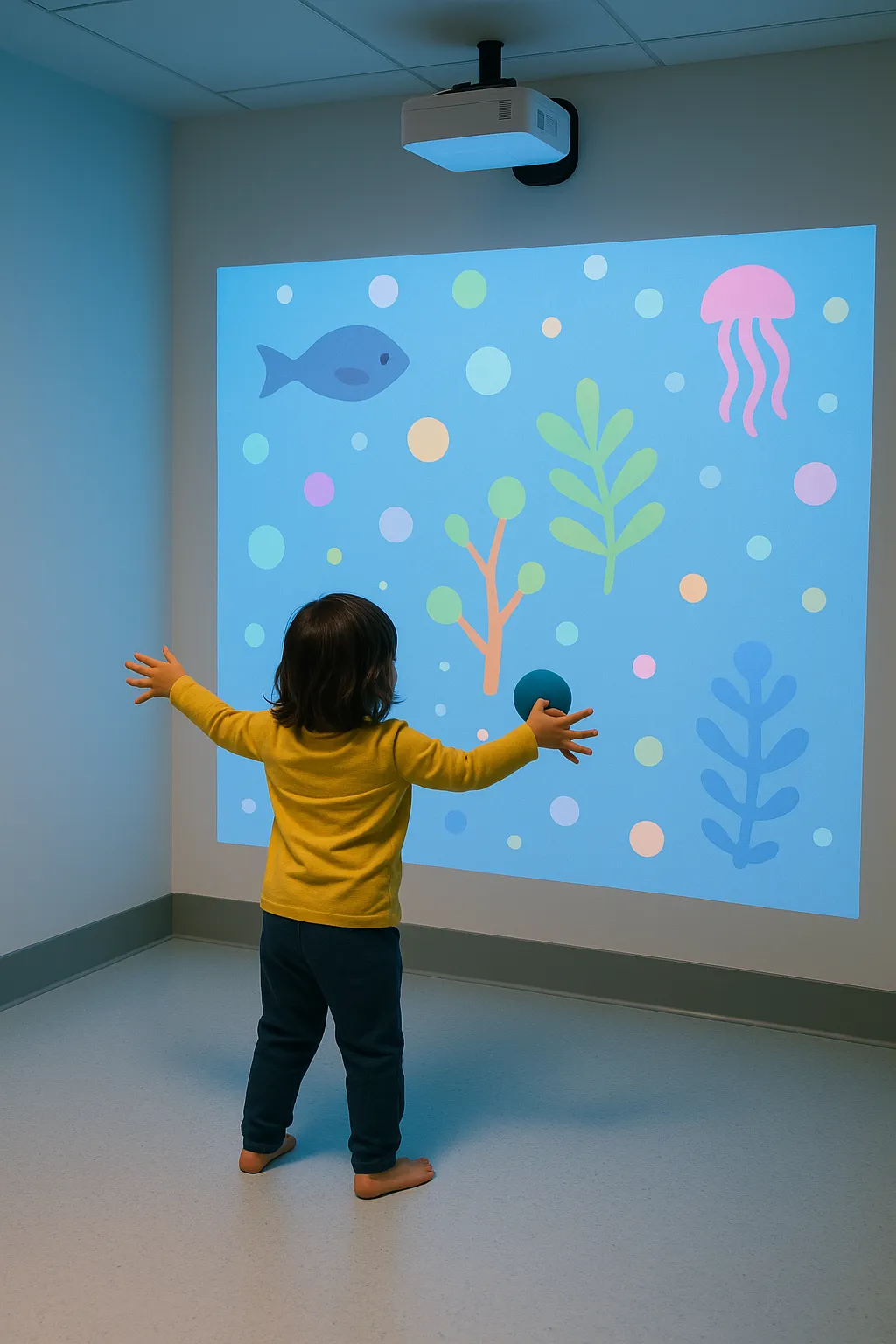
This is where ambient digital tools and interactive sensory environments are becoming especially important. Instead of treating the built environment as passive, hospitals and clinics can use interactive displays, gesture-responsive systems, and AI-supported sensory experiences to make spaces more engaging, accessible, and responsive.
A leading example of this category is the Ouva Sensory Platform, which uses vision-based interaction, computer vision, and large-format digital displays to transform ordinary clinical spaces into interactive environments. These tools can invite children to move, explore, regulate, and play without requiring physical touch. For healthcare settings, touch-free interaction is especially valuable because it supports accessibility, infection-control considerations, and shared use by multiple children and families.
The Lucile Packard Children’s Hospital Stanford Implementation
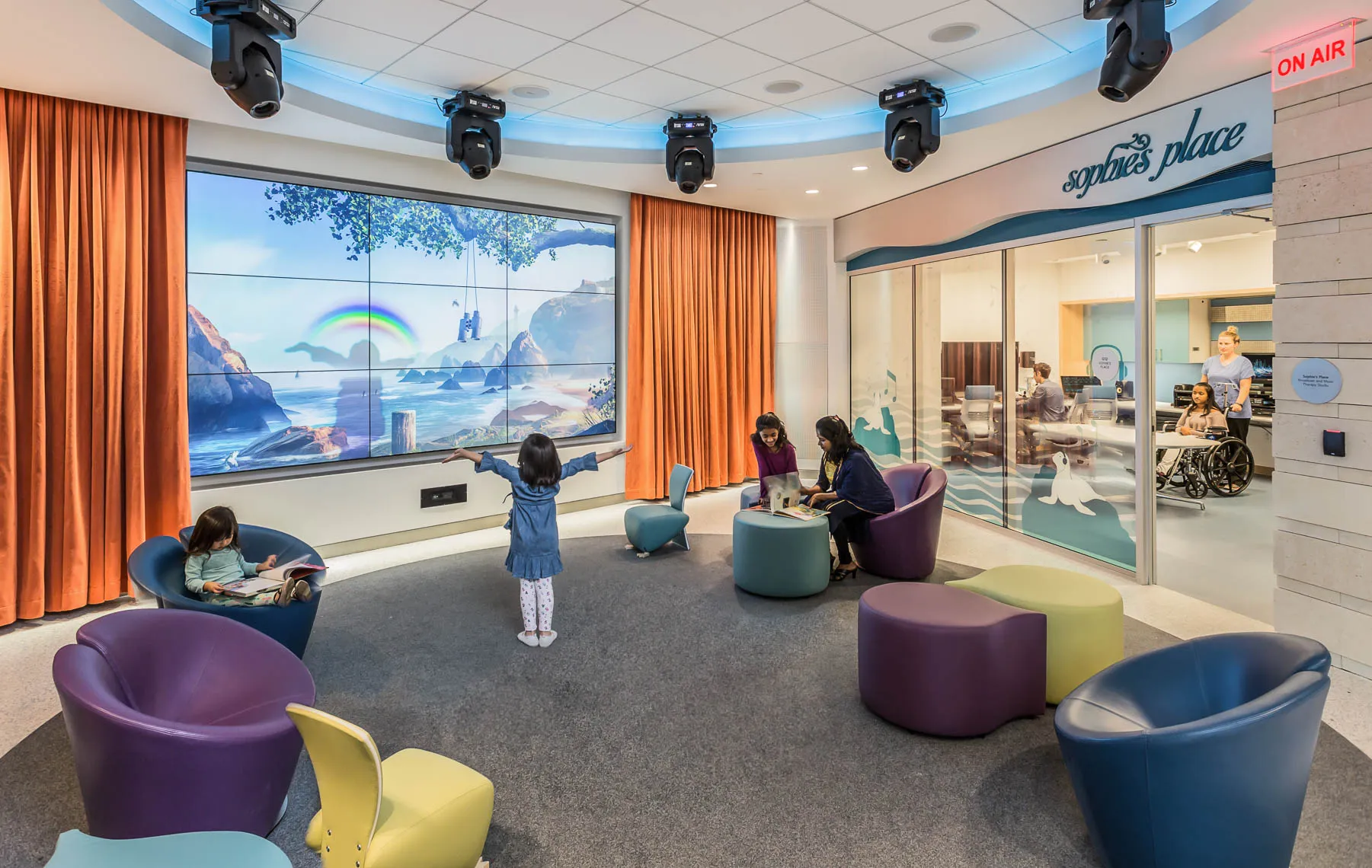
The practical value of interactive sensory environments is demonstrated at Lucile Packard Children’s Hospital Stanford. Stanford Medicine Children’s Health describes the Interactive California Coast Wellness Eco-Zone inside Story Corner as featuring an Ouva Wall: an interactive, gesture-responsive screen where children and families can learn about California coastal ecosystems by moving their bodies in front of the display.
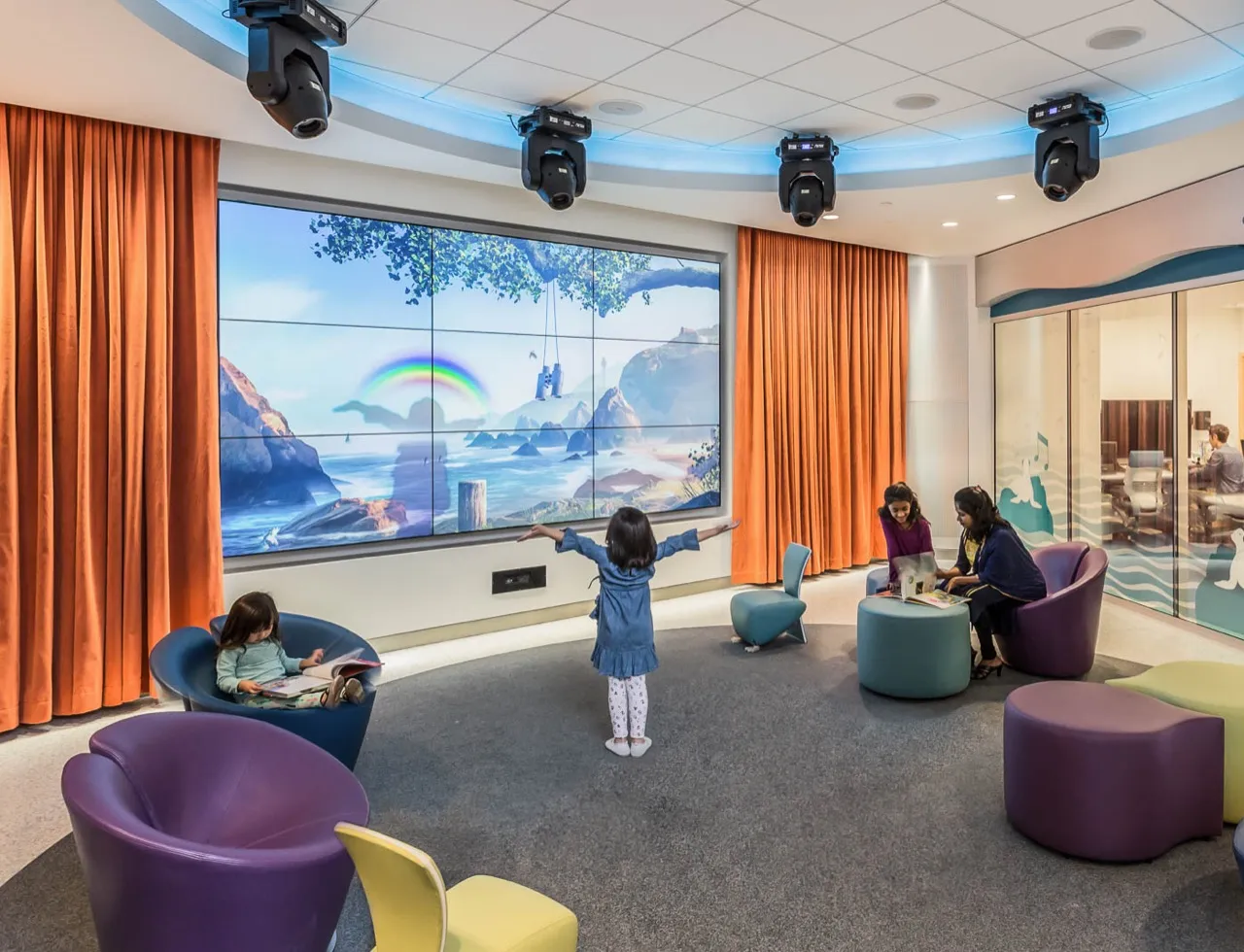
Ouva’s Coastal Life work at Stanford shows how ambient interactive systems can support a more engaging pediatric experience. Rather than asking children to sit passively in a stressful healthcare environment, the experience invites them to participate. Movement becomes a form of interaction. Visual feedback becomes predictable and meaningful. The environment becomes something the child can influence.
For neurodivergent children, that sense of agency can be especially important. Interactive sensory walls can be designed to support several practical goals:
- Motor Engagement: By encouraging children to reach, sweep, step, and gesture, interactive displays can invite movement in a playful, non-clinical way.
- Sensory Processing Support: Predictable visual feedback can help children connect body movement with environmental response, especially when content pacing, brightness, and sound are thoughtfully designed.
- Emotional Regulation and Agency: Calm, responsive environments can help children feel more in control during stressful healthcare visits.
- Social Development and Cooperative Play: Large-format, multi-user displays can support parallel play, shared attention, and cooperative interaction without forcing eye contact or direct verbal exchange.
- Healthcare Experience Design: Interactive tools can help hospitals and clinics make waiting areas, therapy spaces, and family zones feel more welcoming, accessible, and child-centered.
The key is responsible implementation. Interactive sensory tools should be designed around accessibility, privacy, sensory variability, and measurable patient experience. Healthcare leaders should ask whether brightness, motion, audio, content intensity, and interaction style can be adjusted for different users. They should also evaluate what data is collected, how it is protected, and how the organization will measure value over time.
For a deeper look at Ouva’s machine-learning approach to sensory experience at Lucile Packard Children’s Hospital Stanford, read Exploring Machine Learning for Sensory Experience at Lucile Packard Children’s Hospital Stanford. For deployment details, visit the Ouva Interactive Screen page.
What Healthcare Leaders Should Evaluate Before Adopting Autism Digital Tools
As autism technology becomes more sophisticated, the buying decision becomes more complex. A tool may look impressive in a demo but fail in daily use if it does not match the clinical workflow, sensory needs, privacy requirements, or staff capacity of the organization.
Healthcare leaders, BCBAs, SLPs, occupational therapists, and facility administrators should evaluate autism and ABA therapy tools across several dimensions.
Clinical Purpose
Start with the problem the tool is meant to solve. Is the organization trying to improve data collection, reduce documentation burden, support communication, create a calmer waiting area, expand telehealth, improve caregiver engagement, or track outcomes across sites? A platform built for billing may not solve sensory accessibility. A calming app may not provide clinical data. A sensory wall may improve engagement but should not be described as a replacement for therapy.
Evidence and Outcome Measurement
Digital tools should be evaluated according to the evidence behind their specific use case. For ABA data platforms, leaders may measure documentation completion, supervision efficiency, data accuracy, and time to program updates. For AAC tools, the outcomes may include spontaneous communication, vocabulary access, communication-partner modeling, and use across settings. For interactive sensory environments, outcomes may include patient engagement, caregiver feedback, dwell time, staff observations, and accessibility.
Privacy, Security, and Compliance
Autism-related data can be highly sensitive. Clinics should confirm HIPAA obligations, business associate agreement availability, access controls, audit logs, encryption, data retention, and breach-response processes. Families using direct-to-consumer apps should review privacy policies carefully, especially before entering health, behavioral, or location data.
HIPAA scope depends on the relationship between the app, a covered entity, and any business associate. Not every health or therapy app is automatically covered by HIPAA. A consumer app used independently by a family may sit outside HIPAA, while software provided by or on behalf of a clinic may require a different compliance review.
Accessibility and Sensory Design
Neurodivergent users have diverse sensory profiles. Tools should allow customization of sound, visual intensity, pace, color, interaction style, and prompts whenever possible. For healthcare environments, interactive systems should be accessible to wheelchair users, children with limited mobility, users with visual or hearing differences, and children who prefer parallel rather than direct social interaction.
AI Safeguards
AI-powered tools can support documentation, scheduling, ambient interaction, and pattern recognition, but they must be implemented responsibly. Healthcare organizations should ask whether AI features process protected health information, whether customer data is used for model training, whether outputs are reviewed by qualified staff, and how errors are detected and corrected.
Implementation and Training
Technology adoption succeeds when real users are included early. RBTs, BCBAs, SLPs, OTs, caregivers, front-office staff, billing teams, and facilities teams may all interact with the tool in different ways. A successful pilot should test common tasks, staff training needs, accessibility issues, support responsiveness, and data export options before scaling across locations.
To connect this research with Ouva’s ambient clinical AI work, visit Ouva Overview.
Related Reading

Complete Guide to Autism Support: Strategies & Tech 2025
This guide explores the innovative technologies and evidence-based strategies that are revolutionizing autism support in 2025.
Interactive Sensory Walls for Autism (ASD) & Therapy
Discover how AI-powered interactive sensory walls are transforming autism therapy by providing personalized, engaging, and adaptive sensory experiences.

Interactive Display at Lucile Packard Stanford
Discover how Ouva uses machine learning to deliver personalized, interactive sensory room experiences for patients at Lucile Packard Children's Hospital.
Frequently Asked Questions
What is the primary goal of modern ABA therapy?
The core objective of Applied Behavior Analysis is to support meaningful, individualized goals that improve quality of life, communication, independence, safety, participation, and family priorities. Modern ABA should be data-informed, person-centered, and responsive to the autistic individual's needs, preferences, assent, and context.
How do digital ABA therapy apps and software solutions improve outcomes?
ABA therapy apps and digital data-collection tools improve clinical operations by reducing data latency, making graphs easier to review, supporting consistent documentation, and helping supervisors identify when a program may need adjustment. They do not automatically create better outcomes on their own. Their value depends on the quality of the clinical program, staff training, supervision, family collaboration, and how consistently the tool is used.
What are the best Autism/ABA therapy apps for neurodivergent children?
The best app depends on the child's needs. AAC apps may be appropriate for children who need communication support. Visual schedule apps may help with routines and transitions. Sensory apps may support regulation for some users. ABA data platforms support clinicians and therapy organizations rather than serving as direct child-facing tools. Families should prioritize tools that match the child's communication, sensory, motor, and learning profile.
What role do AAC tools play in autism support?
AAC tools can help autistic individuals communicate when speech alone is not sufficient. They can support requesting, commenting, refusing, asking questions, sharing feelings, making choices, and participating socially. AAC should be individualized and modeled consistently across home, school, and clinical settings.
How can interactive sensory tools support hospitals and clinics?
Interactive sensory tools can make healthcare environments more engaging, predictable, and accessible. Gesture-responsive displays such as the Ouva Wall can invite movement, support cause-and-effect play, encourage cooperative interaction, and help children feel more agency in unfamiliar clinical spaces. The strongest implementations pair thoughtful design with accessibility settings, privacy protections, and outcome measurement.
How do practitioners ensure ABA session notes meet compliance using software tools?
Effective ABA session notes should objectively document the session, the interventions used, relevant behavioral data, progress toward goals, caregiver involvement when applicable, and any clinically relevant changes. ABA software can support compliance through structured templates, required fields, timestamped entries, supervisor review, and consistent documentation workflows. Clinicians should still review notes carefully and ensure that documentation reflects what actually occurred.